
The client who said “let me think about it”: the next 30 days

“Let me think about it” is the most common answer after a showing, and the worst handled. Most agents take it as a polite no and stop calling. Others take it as an almost-yes and call every two days until the client stops answering. Both lose the sale. What sits in between is a system, and it fits on one page.
What “let me think about it” really means
It almost never means they didn't like it. If they hadn't, they'd say so, or give a concrete excuse: the price, the area, the orientation. “Let me think about it” means they liked it enough not to close the door, but something is unresolved: the financing, their partner, another property they still want to see, or simply cold feet about deciding.
That something doesn't resolve itself, and it doesn't resolve in a day. It resolves over the following weeks, while the client keeps browsing listings and seeing other homes. The question isn't whether they'll decide, but whether, when they do, you'll be the one in front of them or someone else.
The agent who loses the sale isn't the one who calls too much or too little. It's the one who calls whenever they remember.
The 30 days, week by week
- Day 1, that same afternoon: a short thank-you message with the property's cover photo. Don't ask anything. Just leave the image on their phone.
- Day 3: a useful question, not a sales one. “Did anything come up about the building or the monthly fees?” You give them a reason to reply that isn't “have you decided yet?”.
- Day 7: something new about the property or the area. A photo they hadn't seen, a fact about the neighborhood, a change on the listing. If there's nothing new, don't write.
- Day 14: the call. Just one, two minutes, to find out where they stand. If they say they're still looking, ask what they can't find: they're telling you what to show them.
- Day 21: if they still haven't decided, offer a second showing, or a similar property. Many people buy the second home they see with you, not the first.
- Day 30: if nothing has moved, one last message with no pressure: “If you ever want to see it again, I'm here.” Then archive it with a date to come back in three months.
Six touchpoints in a month. None of them asks “have you decided yet?”. Every one of them gives something. That's the difference between following up and chasing.
Where all of this gets lost
In WhatsApp. Not because WhatsApp is bad (it's where real estate conversations happen) but because it isn't built for finding something again three weeks later. Everything that comes in sinks. The next day there are twenty conversations on top, and the client who said “let me think about it” on Tuesday is buried by Thursday between a voice note and a group chat.
With three active clients you can keep it all in your head. With fifteen you can't. And the agent juggling fifteen is exactly the one losing the most sales this way, without noticing: each one looks like an isolated case.
The minimum system
You don't need a complicated method. You need each client to have three things written down somewhere other than your memory: what stage they're at, which property they saw, and when the next touchpoint is due. With that, the schedule above runs itself, because every morning the tool tells you who's up next.
- Stage: saw it / thinking it over / negotiating / closed or ruled out.
- Property: which one they saw and what the alternative would be if that one falls through.
- Next action with a date: day 3, day 7, day 14. Written down, not remembered.
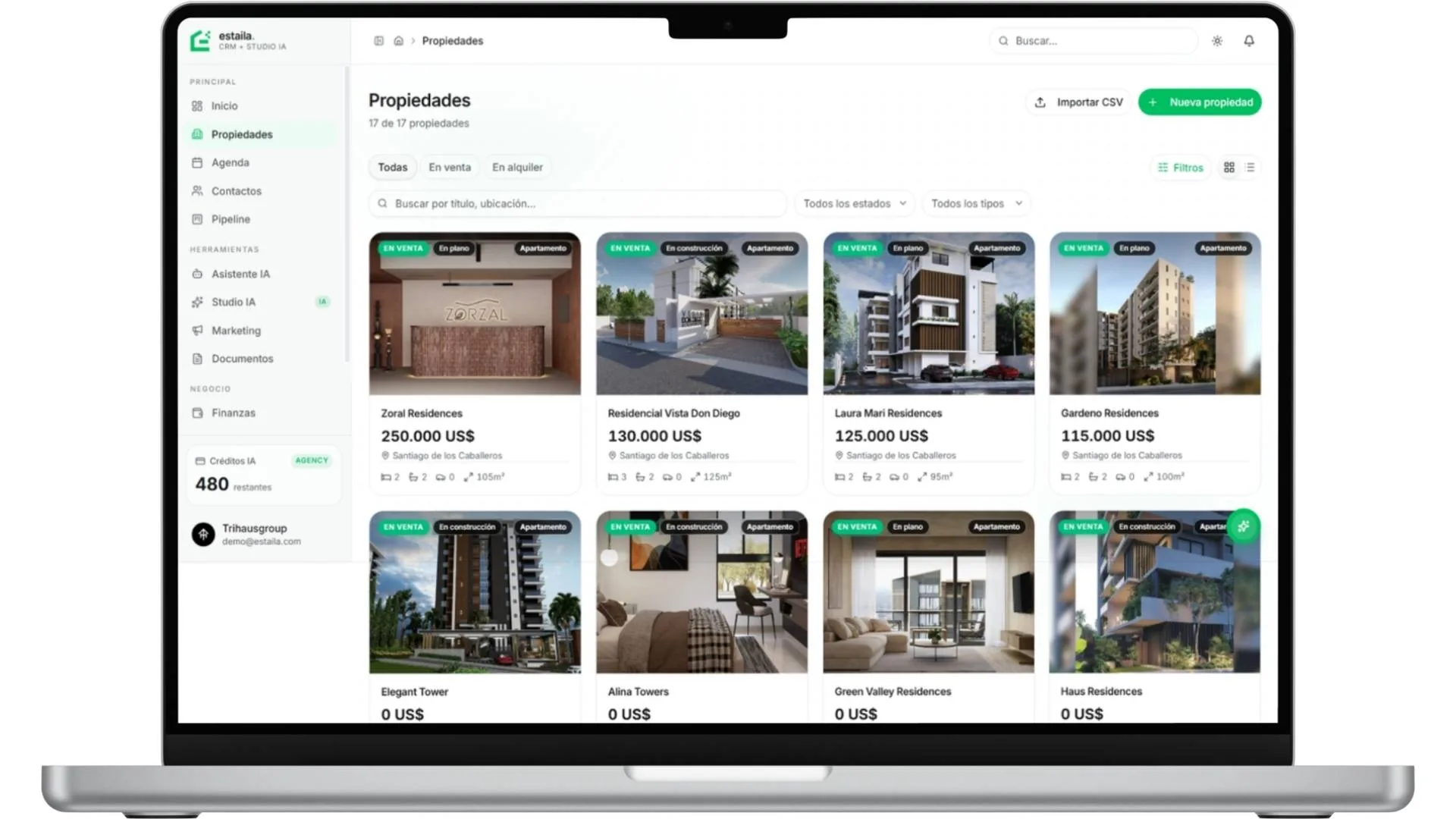
In estaila this is the pipeline and the agenda, and every contact carries the property they saw, with its photos. But the system works just as well in a notebook: what matters is that it exists and that you look at it every morning.
Frequently asked questions
How many times is too many?
More than once a week without bringing anything new. The problem isn't frequency, it's content: six messages in a month that each add something are welcome; three that only ask “have you decided yet?” wear people out.
What if they don't reply to any of them?
Follow the schedule to day 30 and archive it with a date to come back in three months. Many buyers who disappear start looking again when something changes in their life, and the agent who's still there without having pushed is the one they're glad to hear from.
Does the same apply to rentals?
Yes, but compressed: the timeline is days, not weeks. A tenant decides within a week or loses the place. The 30-day schedule becomes a 7-day one, with the same principles: every touchpoint brings something.
Try it with your own photo.
Seven days free, no card needed. When they end you keep the free account; nothing gets deleted.
Start free